
Is Laparoscopic Hysterectomy Better Than Open Surgery?
Introduction: If the Uterus Has to Be Removed, Does the Type of Surgery Matter?
Yes—it can matter a lot.
A hysterectomy is an operation to remove the uterus. But there is more than one way to perform it.
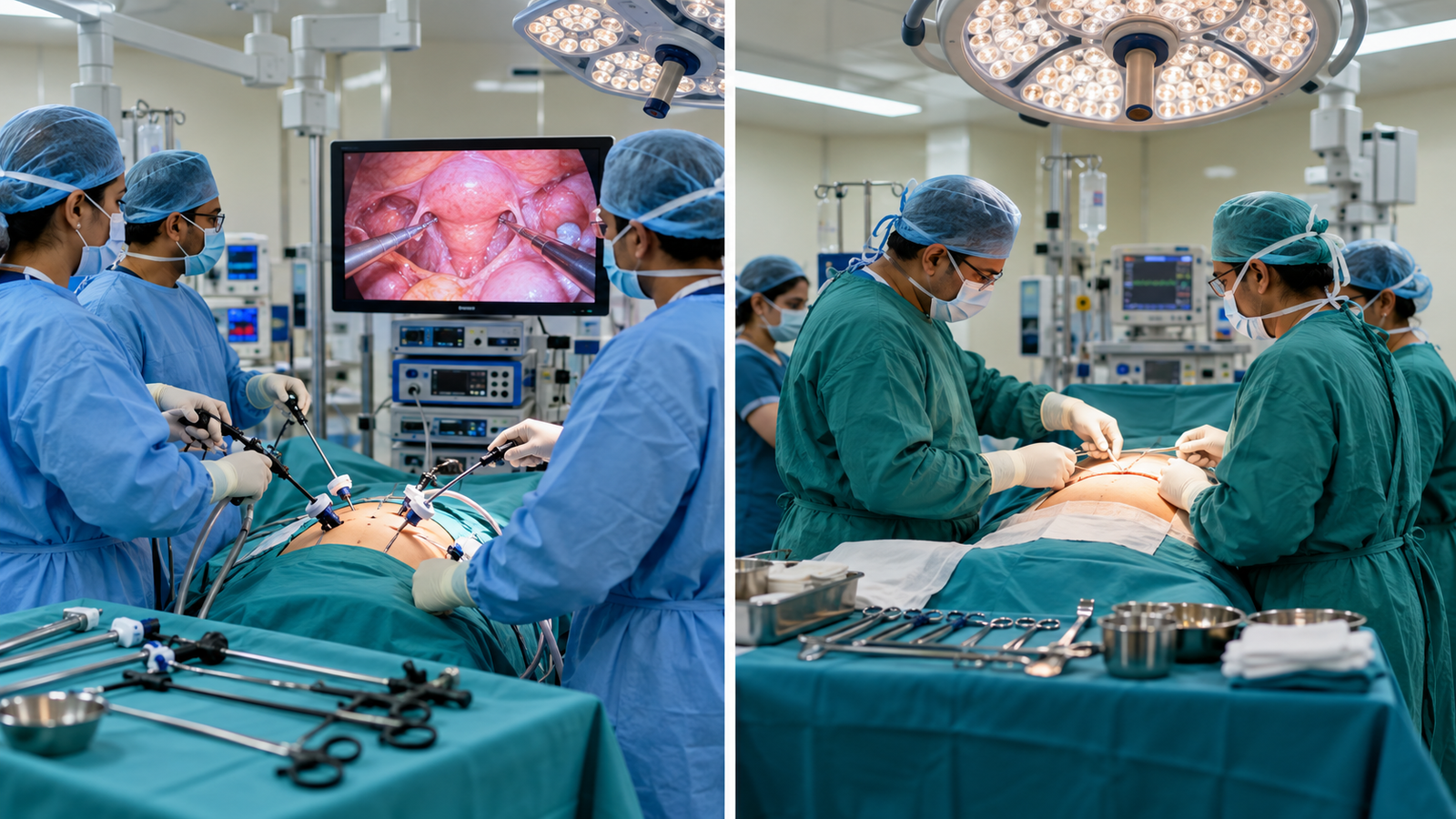
Traditional open abdominal hysterectomy requires a larger incision across or along the lower abdomen.
A laparoscopic hysterectomy, on the other hand, is performed using a camera and specialised instruments through several small incisions.
So patients naturally ask:
Is laparoscopic hysterectomy better than open surgery?
For many women who are suitable candidates, laparoscopic hysterectomy offers important advantages, including less postoperative pain, lower wound-infection risk, shorter hospital stay and an earlier return to normal activities compared with abdominal hysterectomy.
But this does not mean open surgery is outdated or wrong.
Sometimes an open hysterectomy gives the surgeon better access and may be the safest approach.
The best operation is therefore not simply the one with the smallest cuts.
It is the one that provides the safest treatment for that individual patient.
What Is a Hysterectomy?
A hysterectomy means surgical removal of the uterus.
After hysterectomy:
- Menstrual periods stop permanently.
- Pregnancy is no longer possible.
Depending on the condition, the cervix, fallopian tubes or ovaries may also be removed.
Removing the uterus does not automatically mean removing the ovaries.
The exact operation should be discussed before surgery so the patient clearly understands what will and will not be removed.
Symptoms: Why Might Someone Need a Hysterectomy?
A hysterectomy is a treatment rather than a disease, so it does not have its own symptoms.
Instead, it may be recommended because of symptoms caused by another condition, such as:
- Very heavy menstrual bleeding
- Long-lasting periods
- Severe pelvic pain
- Pressure or heaviness in the lower abdomen
- Fibroid-related symptoms
- Persistent abnormal uterine bleeding
- Symptoms from adenomyosis
- Uterine prolapse
- Certain gynecological cancers
Not every patient with these symptoms requires removal of the uterus.
Diagnosis and consideration of less invasive treatments should come first where appropriate.
Causes: Which Conditions May Lead to Hysterectomy?
Uterine Fibroids
Fibroids are non-cancerous growths arising from uterine muscle.
Large or multiple fibroids may cause severe bleeding, pressure, pain or anaemia.
Adenomyosis
This occurs when tissue similar to the uterine lining grows into the muscular wall of the uterus.
It may cause painful and heavy periods.
Endometriosis
Selected patients with severe endometriosis who have completed childbearing and have not improved with other treatments may eventually consider hysterectomy.
Uterine Prolapse
Weak pelvic support can allow the uterus to move downward toward or into the vagina.
Cancer
Certain cancers involving the uterus, cervix or surrounding reproductive organs may require hysterectomy as part of treatment.
The surgical approach for cancer can differ significantly from surgery for a benign condition and should be planned by an appropriately qualified gynecologic oncology team.
Diagnosis Before Hysterectomy
Before recommending surgery, doctors need to understand exactly what is causing the problem.
Evaluation may include:
- Medical history
- Pelvic examination
- Blood tests
- Pelvic ultrasound
- Transvaginal ultrasound
- MRI when required
- Hysteroscopy
- Endometrial biopsy
- Cervical screening
- Other tests depending on the condition
The diagnosis helps determine not only whether hysterectomy is needed, but also which surgical approach is most appropriate.
Treatment: Laparoscopic Hysterectomy vs Open Hysterectomy
What Happens During Laparoscopic Hysterectomy?
During laparoscopic hysterectomy, the surgeon makes several small abdominal incisions.
A thin camera called a laparoscope is inserted, allowing the surgeon to see the pelvic organs on a high-definition monitor.
Specialised instruments are passed through the other small openings.
The uterus is separated from its supporting structures and is commonly removed through the vagina or through an appropriate surgical extraction technique.
Complex laparoscopic hysterectomy may require an overnight hospital stay, although hospital arrangements vary.
What Happens During Open Hysterectomy?
During an open abdominal hysterectomy, the surgeon makes a larger incision in the lower abdomen.
The incision may be horizontal or vertical depending on the operation.
This gives the surgeon direct access to the pelvic organs.
Open surgery can still be particularly useful when the uterus is very large, significant scar tissue or disease is present, or a more extensive operation is required.
Laparoscopic Hysterectomy vs Open Surgery: Quick Comparison
|
|
|
|
|
|
|
|
|
|
|
|
|
|
|
|
|
|
|
|
|
|
|
|
|
|
|
|
|
|
|
|
|
|
|
|
|
|
|
|
ACOG considers minimally invasive hysterectomy preferable to open abdominal hysterectomy when it can be performed safely, while recognising that abdominal hysterectomy remains necessary for some patients.
Benefits of Laparoscopic Hysterectomy
1. Smaller Incisions
Instead of one large abdominal wound, laparoscopic surgery usually requires several small openings.
This means less damage to the abdominal wall.
2. Less Pain After Surgery
One of the major laparoscopic hysterectomy benefits is reduced postoperative pain compared with abdominal hysterectomy for many patients.
ACOG identifies less pain as a key advantage of the laparoscopic approach.
Less pain may also make it easier to start walking and gradually return to everyday movement.
3. Shorter Hospital Stay
Patients undergoing uncomplicated minimally invasive hysterectomy frequently leave hospital sooner than those undergoing open surgery.
Many patients undergoing total laparoscopic hysterectomy can go home the following day, although this depends on the patient and procedure.
4. Faster Recovery
Recovery is one of the biggest differences patients notice.
Minimally invasive hysterectomy generally allows an earlier return to normal activity compared with open abdominal surgery.
That does not mean internal healing happens instantly.
Even with tiny external incisions, significant healing is still taking place inside the pelvis.
5. Smaller Scars
Small laparoscopic incisions generally leave much smaller scars than an abdominal incision.
Appearance should never be the main reason for selecting surgery, but this can be an additional benefit.
6. Lower Risk of Some Wound Complications
Compared with open abdominal hysterectomy, laparoscopic surgery has a lower risk of wound or abdominal-wall infection.
This is partly because the abdominal incisions are much smaller.
So Is Laparoscopic Hysterectomy Always Better?
No.
This is important.
Laparoscopic hysterectomy may offer better recovery, but it is not necessarily the better operation for every patient.
Open surgery may be considered when there is:
- A very enlarged uterus
- Extensive adhesions from previous operations
- Difficult or distorted anatomy
- Extensive disease outside the uterus
- Certain cancers
- A need for additional major procedures
- An emergency or complication
- A situation where laparoscopic access would not be safe
The size and shape of the uterus, previous surgery, surrounding disease, surgeon experience and available facilities all influence the best route.
What Are the Risks of Laparoscopic Hysterectomy?
Laparoscopic hysterectomy is still major surgery.
Possible complications include:
- Bleeding
- Infection
- Blood clots
- Anaesthesia-related problems
- Bladder injury
- Ureter injury
- Bowel injury
- Urinary problems
- Need to convert to open surgery
ACOG notes that while laparoscopic hysterectomy has several recovery advantages, it can take longer to perform and has an increased risk of urinary-tract or nearby-organ injury compared with some approaches.
A recent UCLH patient guide also lists urinary-tract, bladder, ureter and bowel injuries among possible complications and notes that conversion from laparoscopy to open surgery can sometimes be necessary.
Is Conversion to Open Surgery a Failure?
No.
Sometimes the surgeon starts laparoscopically but encounters:
- Severe scar tissue
- Unexpected anatomy
- Bleeding
- Difficulty seeing structures safely
- Other unexpected findings
The operation may then be converted to an abdominal incision.
This should not automatically be viewed as a failed operation.
Changing to open surgery can be a safety decision.
The surgeon's first priority is completing the operation safely—not proving that it can be finished through small cuts.
Recovery: How Different Is It?
After Laparoscopic Hysterectomy
Patients often begin walking soon after surgery.
Some may go home the same day or after one night, depending on the operation and hospital protocol.
Pain and tiredness are expected, but recovery is generally quicker than after abdominal hysterectomy.
Cleveland Clinic notes that vaginal and laparoscopic hysterectomy recovery commonly takes around 2–4 weeks, while overall recovery varies by individual and procedure.
After Open Abdominal Hysterectomy
A larger incision means more abdominal-wall healing is required.
Hospital stay is usually longer, and returning to normal activities generally takes more time.
Recovery after abdominal hysterectomy can take approximately six weeks or longer depending on the patient and operation.
These are general estimates—not guaranteed deadlines.
Warning Signs After Either Type of Hysterectomy
Contact your surgical team promptly if you develop:
- Fever
- Increasing rather than improving pain
- Heavy vaginal bleeding
- Foul-smelling discharge
- Redness or pus from a wound
- Persistent vomiting
- Difficulty passing urine
- Increasing abdominal swelling
Seek urgent medical attention for chest pain, difficulty breathing, fainting or severe swelling/pain in one leg, as these could indicate a serious complication.
Benefits of Choosing the Right Surgical Approach
The real benefit does not come from choosing laparoscopy simply because it sounds modern.
It comes from matching the operation to the patient.
When laparoscopic hysterectomy is appropriate, patients may benefit from:
- Smaller wounds
- Less postoperative pain
- Shorter hospitalization
- Faster recovery
- Smaller scars
- Lower risk of some wound problems
- Earlier return to normal daily activities
When open surgery is genuinely necessary, its benefit is equally important:
better access for a difficult or extensive operation when patient safety requires it.
The Better Surgery Is the One That Is Safest for You
For many patients, the answer to “Is laparoscopic hysterectomy better than open surgery?” is:
Yes—when laparoscopic surgery can be performed safely.
Smaller incisions, less pain, shorter hospital stays and quicker recovery are meaningful advantages.
But a patient should never be promised laparoscopic surgery before the surgeon understands the full clinical situation.
Sometimes open surgery provides the safest route.
That is why the better question is:
“Which approach gives me the safest operation with the best expected recovery?”
Patients considering hysterectomy in Visakhapatnam should undergo evaluation by an appropriately qualified gynecologist or gynecologic surgeon.
Where multidisciplinary laparoscopic surgical expertise is clinically relevant, Dr. Naveen Kumar Anem, MBBS, DNB (General Surgery), FMAS, FIAGES, Laparoscopic & GI Surgeon, may contribute according to the hospital's clinical team and the individual patient's condition.
Been Advised to Have Your Uterus Removed?
Before surgery, ask your treating team:
Can my hysterectomy be performed laparoscopically?
Why are you recommending this surgical route?
How long will I stay in hospital?
How long will recovery take?
What could make open surgery necessary?
Understanding these answers can help you enter surgery with realistic expectations and greater confidence in your treatment plan.
!! Book Your Appointment Today !!
Medical Review
Recommended publication wording after clinical approval:
✅ Gynecology Review:
Laparoscopic Surgical Contributor, where clinically applicable:
Dr. Naveen Kumar Anem
MBBS, DNB (General Surgery), FMAS, FIAGES
Laparoscopic & GI Surgeon
This article is intended for general patient education. The safest route for hysterectomy depends on the diagnosis, anatomy, surgical complexity and individual health. It does not replace personalised advice from a qualified gynecologic surgeon.